The Deterrent’s Edge
The center held. Nobody promised the edges would.

The war’s opening strikes were aimed squarely at Tehran’s chain of command, and the government did not collapse. Within days it had reconstituted itself. Whatever anyone expected from a decapitation campaign aimed at the center, that particular bet didn’t pay off — which means the entire “post-collapse” theory of Iranian fragmentation, the idea that partition follows regime collapse the way rubble follows a demolition, was wrong on its own terms before it ever got tested. Something else happened instead, and it’s more interesting than collapse would have been.
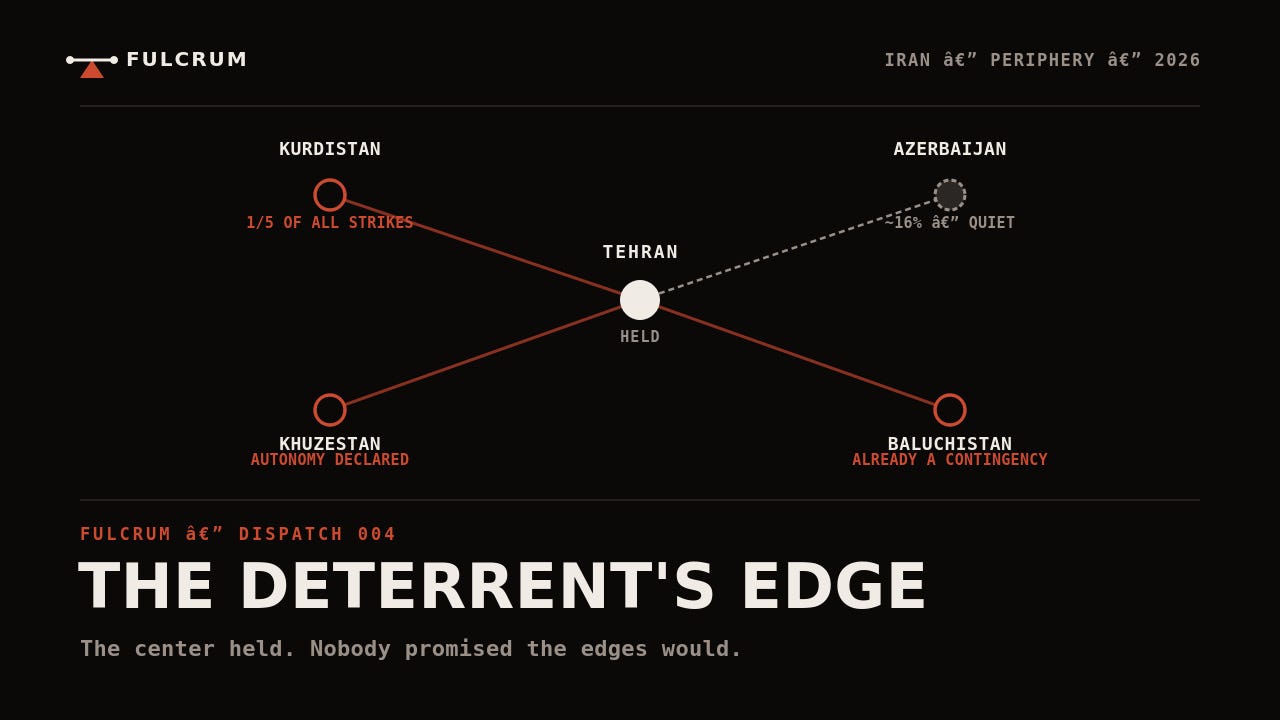
While the war’s most visible violence concentrated on Tehran, roughly a fifth of every airstrike the United States and Israel fired landed somewhere else entirely: Iranian Kurdistan. Kermanshah, a Kurdish city few outside the region could have placed on a map a year ago, took the second-highest number of strikes of anywhere in the country — more than any city except the capital itself. The targets weren’t symbolic. They were the actual machinery of internal control: Basij compounds, police stations, intelligence department complexes, IRGC garrisons, the border posts that exist specifically to keep Kurdish opposition groups based across the border in Iraq from moving the other way. Whatever the stated objective of those strikes, their effect was to hollow out, province by province, the apparatus Tehran uses to make sure Kurdistan stays a province.
Tehran noticed. Six days before the war started, five Iranian Kurdish parties, fractured across decades of exile, formally united into a single coalition with one stated aim: removing the Islamic Republic and securing Kurdish self-determination. Within days of the war beginning, that coalition said its political leadership and its armed wings were now moving in step with the fighting. By early March, one senior party figure claimed forces were already inside Iran and that operations would begin soon — a claim other Kurdish officials publicly denied, but one Iran itself evidently took seriously. Iran’s response wasn’t restraint. It was preemptive missile strikes on Kurdish party compounds inside Iraq’s sovereign territory, and an open threat to hit every facility the Kurdistan Region of Iraq had if it let militants cross. That is not the posture of a state confident in its border. It’s the posture of one that already knows the border doesn’t hold on its own.
Fifteen hundred kilometers south of Kurdistan, in Khuzestan — the province that produces most of the oil funding everything the Islamic Republic does, including the security services now stretched thin fighting fires in the northwest — the Ahwazi Arab minority made a parallel argument in real time. Their political organizations issued a public statement describing themselves as a nation absorbed into the Iranian state by force, not by choice, and called for a collective mobilization toward self-determination and the restoration of the provincial autonomy Khuzestan held before Pahlavi-era centralization dissolved it. This is not a new grievance. It is an old one that picked the exact moment Tehran’s attention and security resources were pinned down elsewhere to become an active one again.
Further east, Baluchistan didn’t even need to mobilize to become a live variable. Pakistan — a nuclear state whose actual strategic focus never leaves its eastern border with India — still found itself reorganizing part of its calculus around the possibility that a fragmenting Iran could hand new momentum to Baloch insurgent networks operating on both sides of that border. Islamabad’s worry wasn’t abstract solidarity with Tehran. It was that a hollowed-out Iranian state next door doesn’t stay contained to Iranian territory, and that the same fracture line runs straight through Pakistani soil. When a neighboring nuclear power starts quietly gaming out your internal fault lines without you having to ask, the fault line has already stopped being hypothetical.
The quietest fault line is also the largest. Azeri Turks make up something like a sixth of Iran’s entire population, concentrated in the northwest provinces along the border with the Republic of Azerbaijan — a separate, sovereign, ethnically Azeri state that has spent the last decade building real military confidence of its own. Iranian Azerbaijan didn’t organize a coalition or issue a declaration during this war. It didn’t have to. A minority that size, sitting on an open border with a state that shares its language and its politics could, in some future crisis, offer more than sympathy — doesn’t need to move to matter in every planning document written about Iran’s next decade. It only needs to still be there once the provinces that did move this time are finished being triaged.
None of this required Tehran to fall. That’s the part the collapse theory got backward. Partition was never a bet on the center losing power. It was always a bet on the periphery losing its keeper — on the specific, unglamorous provincial security infrastructure that makes a multi-ethnic state cohere getting spent faster than it can be rebuilt, while the state’s attention and resources stay locked on defending the capital and the chain of command. That’s exactly what a fifth of this war’s violence did to Kurdistan, what a barely-interrupted oil economy is doing to test Khuzestan’s patience, and what Pakistan is already pricing into its own force posture regarding Baluchistan. The center held. Nobody promised the edges would.
What comes next isn’t a single collapse anyone can put a date on. It’s a slower, uglier accounting: which of these provinces gets its security architecture rebuilt first, which gets triaged, and how long a state can keep three separate peripheral fires from becoming the same fire. Iran has answered that question before, in earlier decades, by rebuilding fast and rebuilding hard. The difference this time is that it has to do it in three places at once, with a security budget that just spent a war defending the center, against opposition movements that spent the same war getting organized, armed, and, in Kurdistan’s case, already crossing the line on the map that used to matter.