The Patience Weapon
China isn’t racing toward nuclear parity. It already decided the old order doesn’t bind it.

Twenty warheads. That’s how much China’s stockpile grew over the past year, according to the most recent independent count — a modest number next to the alarm it generates, and that’s the point. Twenty warheads is not a sprint. It’s a state that has already concluded it’s going to win the race on schedule and sees no reason to hurry.
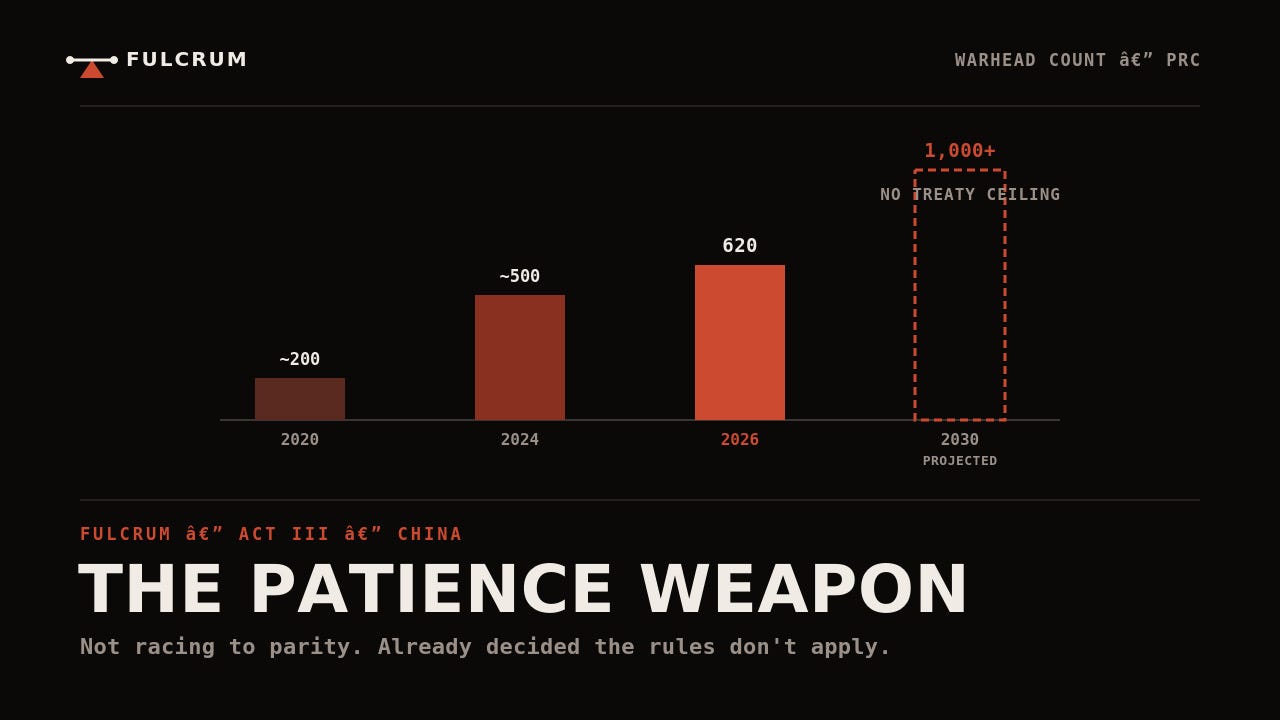
The bigger number is the one underneath the annual increment: 775 land-based missile silos as of this year, spread across three major new fields in China’s north and east, loaded faster than any other nuclear power on the planet has ever loaded silos in peacetime. China’s stockpile now sits at roughly 620 warheads and is projected past 1,000 by the end of the decade. Its inventory of nuclear-capable ballistic missile launchers has already passed both Russia’s and the United States’. None of this required a crisis, a negotiation, or a public decision anyone had to defend. It happened the way infrastructure happens: quietly, on schedule, without anyone’s permission.
Compare the two paths on offer. Iran hedged in the open — enriched to 60 percent, stopped short of a weapon, negotiated for fifteen months, and got struck twice for the trouble of being visible and unfinished at the same time. China skipped the hedge entirely. It was never a party to the US-Russia arms control architecture in the first place, which means its build-out happens in a genuine regulatory vacuum: no treaty text to violate, no verification regime to defy, no ceiling anyone agreed to and can now point to being broken. New START — the last major bilateral cap on any nuclear arsenal on earth — expired this year with nothing built to replace it. China was never bound by it. There was nothing for Beijing to walk away from, because it never sat down at that particular table.
Officially, the doctrine hasn’t changed. Beijing still describes its posture as minimum deterrence and no first use, and says so in writing, most recently in a formal government white paper that reaffirmed both commitments while declining to explain the buildup underneath them. But the hardware is drifting somewhere the doctrine doesn’t fully cover. Development of lower-yield warheads, new space- and ground-based early-warning systems, and a shift toward what Chinese planners call “early warning counterstrike” — launching on detection rather than after impact — all point toward a force built for options a pure minimum-deterrence posture wouldn’t need. A no-first-use pledge is a promise about intentions. Intentions are exactly the thing offensive realism says no state can afford to take on faith, China’s own included.
What makes this strategy work isn’t secrecy — the silo fields are visible from commercial satellites and have been since 2021 — it’s tempo. A state that announced a crash program would invite exactly the kind of scrutiny and pressure that spent a year fixing world attention on 440 kilograms of Iranian uranium. A state that quietly pours a few hundred silos a year while insisting nothing has changed gets to cross the same threshold without ever supplying a moment anyone can rally around. By the time the number is undeniable, there’s no longer a preventive window in which anyone could plausibly do anything about it. Patience isn’t the opposite of a weapons program. At this scale, it is the weapons program.
The clearest measure of what that patience buys is sitting ninety miles off China’s coast. Taiwan’s security has rested for decades on strategic ambiguity — Washington’s deliberate refusal to say in advance whether it would fight for the island, a policy built for a world where the power gap between the US and China was wide enough that the threat of intervention didn’t need to be explicit to be credible. That gap is the thing closing. A January poll found only 34 percent of Taiwanese consider the United States a credible partner that keeps its word, a number that collapses along party lines — matched by a President who, fresh from a Beijing summit, described a previously approved arms package to Taiwan as a negotiating chip and put it on hold. None of that is a formal policy shift. It doesn’t need to be. Ambiguity that was once a deterrent starts reading as a hedge the moment the public on the receiving end stops believing it, and Taiwan’s public increasingly does.
This is the same lesson Iran just learned, arriving by the opposite road. Iran’s ambiguity was policed because Iran could still be struck — its facilities were reachable, its stockpile was locatable, its leadership was killable in a war that started and ended within months. China’s ambiguity isn’t policed at all, because at 620 warheads and climbing past a thousand, with a missile inventory already larger than Washington’s, there is no longer a plausible preventive strike on the table, and everyone involved already knows it. The instrument that made Iran’s hedge fatal — the fact that someone could still act on it — is the exact instrument China spent twenty-five years quietly building its way out of range of.
Nuclear latency was supposed to be the equalizer for states that couldn’t otherwise compete. China has already moved past that stage into something the framework doesn’t have a name for yet: a great power simply declining to ask permission, on a timeline nobody else gets a vote on, backed by a number that will finish climbing right on schedule whether the rest of the world is ready for it or not.